
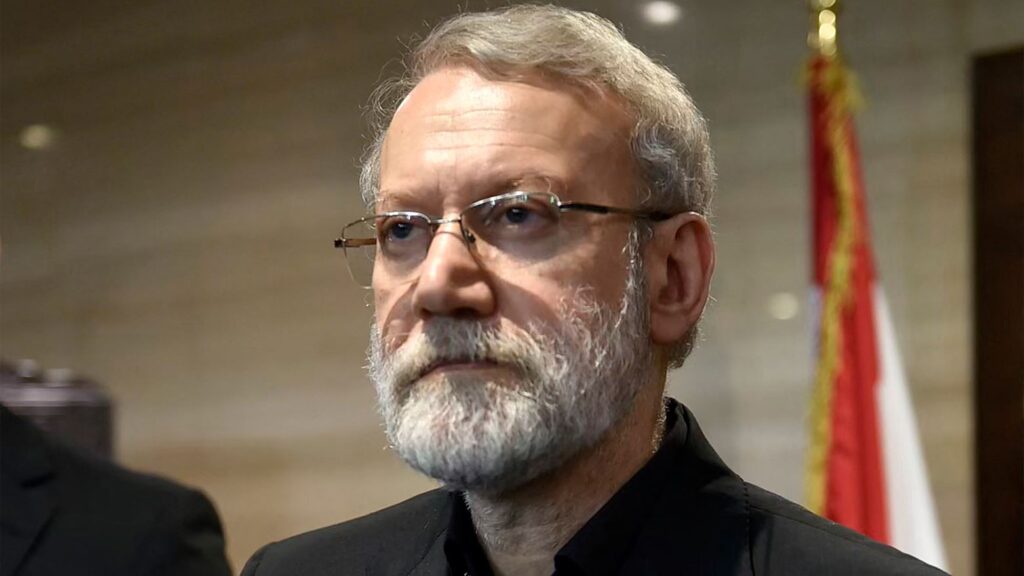
Image: from Rudaw English X @RudawEnglish
SECRETARY OF IRAN’S SECURITY COUNCIL KILLED IN PRECISION AIRSTRIKE; “CHIEF STRATEGIST” OF REGIME REMOVED
By OPEN CHRONICLE STAFF with Agencies
JERUSALEM — In a move that threatens to ignite an all-out regional war, the Israel Defense Forces (IDF) confirmed Tuesday that they have successfully eliminated Ali Larijani, the Secretary of Iran’s Supreme National Security Council and a foundational pillar of the Islamic Republic’s power structure. Larijani, widely regarded as the “de facto leader” of Iran’s strategic operations, was killed in a precision airstrike on a safe house in Tehran during the overnight hours of March 17.
Israeli Defense Minister Israel Katz hailed the operation as a “monumental achievement” in dismantling the “architecture of terror” that has defined Iranian foreign policy for decades.
Defense Minister Israel Katz said the Israeli military had killed Iran's security chief Ali Larijani and the head of its Basij militia in airstrikes overnight pic.twitter.com/aoO7x3gDiN
— Reuters (@Reuters) March 17, 2026
The Architect of Expansion
Ali Larijani was far more than a bureaucrat; he was the regime’s premier ideologue and the man considered the “father” of the current Iranian nuclear program. His resume spanned every major center of power in Tehran:
-
Nuclear Negotiator: Headed the nuclear files during their most critical expansion phases.
-
Legislative Power: Served as the long-time Speaker of the Iranian Parliament (Majlis).
-
Media Control: Former head of the IRIB broadcasting company, where he designed the state’s massive propaganda apparatus.
-
IRGC Veteran: Held high-ranking leadership positions within the Islamic Revolutionary Guard Corps.
“Larijani was the bridge between the theocratic leadership and the military-industrial complex,” said Amos Yadlin, a former Israeli military intelligence chief. “His removal is not just a tactical loss for Iran; it is the loss of their most sophisticated strategic mind.”
Role in Domestic Suppression
The IDF’s press service emphasized that Larijani was a primary target not only for his external aggression but for his role in domestic brutality. Intelligence reports indicate that Larijani was the coordinator-in-chief for the suppression of recent pro-democracy protests within Iran.
According to Israeli officials, he oversaw the “mass crackdown” on civilian protesters, coordinating the IRGC and Basij forces to stifle dissent through digital blackouts and lethal force. “The man who designed the cage for the Iranian people is no longer there to lock it,” Katz stated.
A High-Stakes Escalation
The strike marks a dramatic shift in Israeli strategy, moving from targeting “proxies” and mid-level commanders to the direct elimination of the regime’s inner circle on Iranian soil. Larijani had reportedly arrived at the safe house only 24 hours before the strike, suggesting a significant intelligence breach within the highest levels of the Iranian security state.
While Israel has claimed responsibility, Tehran has yet to officially confirm Larijani’s death, though state media has transitioned to playing somber music, a traditional precursor to mourning announcements.
Global Reactions
The international community has reacted with a mix of shock and alarm. While the U.S. administration has not officially commented on the strike, sources in Washington suggest the U.S. was “notified but not involved.”
Geopolitical analysts warn that Iran’s “strategic patience” may have reached its limit. “There is no replacing a figure like Larijani,” noted Dr. Ray Takeyh of the Council on Foreign Relations. “The regime will feel compelled to respond in a way that restores its deterrence, which puts every asset in the Middle East at risk.”
As of Tuesday evening, the IDF has moved to its highest alert level, anticipating a multi-front retaliation from Iran and its remaining regional allies.