
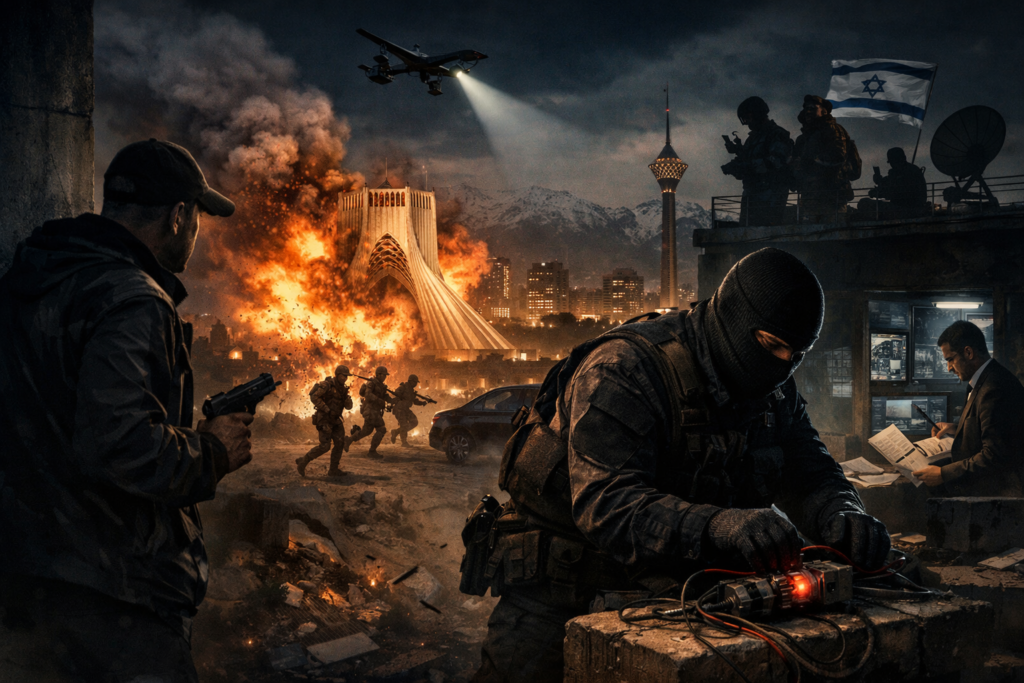
Image Credentials: Image Title: Shadow War in Iran: How Mossad Executes Deep Covert Operations Source: (sora.openai) Date: March 2026. Attribution: This image was created using AI-generated imagery
By OPEN CHRONICLE STAFF
For decades, the confrontation between Israel and Iran has largely unfolded in the shadows. Rather than open battlefield clashes, the conflict frequently manifests through covert operations, cyber warfare, sabotage, and targeted assassinations. At the center of many of these operations is Mossad, Israel’s foreign intelligence service, widely regarded as one of the most capable covert organizations in the world.
Recent reporting about the killing of Ali Larijani in a precision strike near Tehran illustrates the operational model that has defined Israeli covert strategy for years. While such strikes are often carried out by the Israel Defense Forces or the Israeli Air Force, the intelligence architecture behind them frequently originates with Mossad.
Understanding how these operations work requires examining not just the strike itself, but the entire intelligence ecosystem that precedes it, often months or years in the making.
Israel’s covert campaign against Iran is built around a strategic concept commonly known as decapitation, the removal of key leadership figures who play central roles in military planning, technological development, or strategic coordination.
Targets in such campaigns typically fall into several categories:
• senior political decision makers
• commanders within the Islamic Revolutionary Guard Corps
• scientists linked to nuclear development
• logistical coordinators for regional proxy forces
The goal is not simply the elimination of individuals. The broader objective is to disrupt networks of expertise and decision-making that are difficult to replace quickly.
Operations linked to the deaths of figures such as nuclear scientist Mohsen Fakhrizadeh illustrate this strategy clearly. Removing a central architect of a sensitive program can delay or destabilize an entire institutional effort.
The foundation of any Mossad operation is human intelligence, often referred to as HUMINT.
Inside Iran, intelligence networks are believed to include:
• recruited insiders within security institutions
• informants within logistics and infrastructure sectors
• members of opposition networks
• commercial intermediaries used for surveillance or access
Through these sources, Mossad can gather critical operational details, including:
• addresses and safe houses
• travel schedules
• bodyguard patterns
• personal communication habits
The first step in targeting an individual like Ali Larijani would likely involve months of monitoring to establish reliable information about daily movements and security routines.
This phase is slow and meticulous. Intelligence analysts construct what is known as a pattern of life profile, mapping when a target is mobile, when they are stationary, and when security coverage is weakest.
Human sources are only one layer. Israeli intelligence also relies heavily on advanced signals intelligence capabilities, often associated with units such as Unit 8200.
These capabilities can include:
• interception of communications metadata
• cyber infiltration of digital systems
• device geolocation tracking
• monitoring of encrypted messaging patterns
Even when communication content is inaccessible, metadata can reveal relationships and movements. For example, analysts can identify meetings by observing when multiple devices converge at a location.
This fusion of human sources and digital intelligence allows analysts to confirm a target’s presence with high confidence before an operation proceeds.
Many Mossad operations rely on equipment that is placed inside the target country well in advance.
Smuggling and logistics networks often move components in pieces through commercial supply chains or covert channels. These networks may operate through:
• front companies
• transportation firms
• import export businesses
• construction contractors
The objective is to avoid the need for Israeli personnel to be physically present during the attack itself.
In the assassination of Mohsen Fakhrizadeh, reports suggested that a remotely controlled weapon system had been assembled and positioned before the attack took place. The system could be triggered once the target vehicle entered a specific location.
The final step before a strike is real-time confirmation.
Even with months of surveillance, operations usually wait for a final signal confirming that the target is physically present. This confirmation may come from:
• a human source near the location
• electronic device tracking
• drone surveillance
• communications monitoring
Only after this confirmation does the operational chain move forward.
At that stage, Mossad intelligence is transmitted to operational units within the Israeli military.
The final phase is typically executed by the Israel Defense Forces or the Israeli Air Force.
The weapons used depend on the environment and operational constraints:
• precision-guided bombs from aircraft
• stand-off missiles launched outside hostile airspace
• armed drones
• covert explosive devices
• remotely operated weapon systems
The central principle is precision. Operations are designed to eliminate a specific target while minimizing broader damage, both for operational secrecy and for political reasons.
One of the most remarkable operations attributed to Mossad occurred in 2018, when Israeli agents reportedly seized thousands of documents from a secret warehouse in Tehran.
The facility contained archives connected to the nuclear weapons research effort known as the Amad Project.
Agents reportedly entered the building overnight, opened dozens of safes with specialized equipment, and extracted tens of thousands of documents and digital files.
The materials were later publicly presented by Benjamin Netanyahu, who argued they proved Iran had previously pursued nuclear weapons capabilities.
The operation demonstrated not only intelligence penetration but also the logistical ability to move sensitive materials out of the country undetected.
Between 2010 and 2012, several Iranian nuclear scientists were killed in attacks in Tehran.
Victims included:
• Masoud Alimohammadi
• Majid Shahriari
• Mostafa Ahmadi Roshan
In several cases, attackers riding motorcycles attached magnetic explosive devices to vehicles in traffic before quickly escaping.
These operations highlighted a different operational model, one involving small local teams rather than remote systems or airstrikes.
Covert operations are not purely tactical. They also produce psychological and political effects.
Repeated penetrations of Iranian security have raised questions inside Iran about internal security failures and potential infiltration.
Each successful operation signals several messages:
• Israeli intelligence can reach deep inside Iran
• Senior officials are vulnerable even in heavily guarded environments
• Security institutions may contain internal leaks
This psychological pressure forces the Iranian leadership to adopt more restrictive movement patterns, which can complicate governance and decision-making.
Despite its extensive security apparatus, Iran has repeatedly experienced intelligence breaches.
Analysts often point to several structural factors.
First, the security system includes multiple organizations with overlapping authority, particularly the Islamic Revolutionary Guard Corps and other state security bodies. Competition between agencies can create gaps in coordination.
Second, political and ideological divisions inside the country can create opportunities for the recruitment of insiders.
Third, Israel’s technological advantages in cyber intelligence and surveillance create a strong asymmetry in information capabilities.
The alleged strike on Ali Larijani represents another chapter in a long covert struggle between Israel and Iran. These operations illustrate how modern intelligence warfare blends human networks, cyber capabilities, advanced weapons systems, and psychological strategy.
Unlike traditional wars fought on visible battlefields, this conflict operates largely out of public view, unfolding through clandestine missions, sabotage campaigns, and precisely targeted attacks.
In this shadow war, information is often the most decisive weapon. Mossad’s operational model demonstrates that the success of such missions depends less on the strike itself and more on the intelligence architecture built long before the attack occurs.
Bibliography
- Reuters. “Ali Larijani, Iran’s Ultimate Backroom Powerbroker, Dies after Israeli Strike.” March 17, 2026.
- The Guardian. “Iran’s National Security Council Confirms Death of Ali Larijani in Israeli Airstrike.” March 17, 2026.
- The Washington Post. “Israel Says It Killed Iran’s Top Security Official in Targeted Strike.” March 17, 2026.
- Open Chronicle. “Decision Strike: Israel Eliminates Ali Larijani in Tehran Raid.” March 17, 2026.
- Benjamin Netanyahu. “Presentation on Iran’s Nuclear Archive.” Government of Israel Press Conference, April 30, 2018.
- Assassination of Mohsen Fakhrizadeh. International reporting on the November 27, 2020, attack near Absard.
- Killing of Masoud Alimohammadi. Tehran, January 12, 2010.
- Assassination of Majid Shahriari. Tehran, November 29, 2010.
- Killing of Mostafa Ahmadi Roshan. Tehran, January 11, 2012.
- Studies on intelligence operations conducted by Mossad.
- Research on signals intelligence capabilities associated with Unit 8200.
- Analyses of the structure and operational role of the Islamic Revolutionary Guard Corps.