
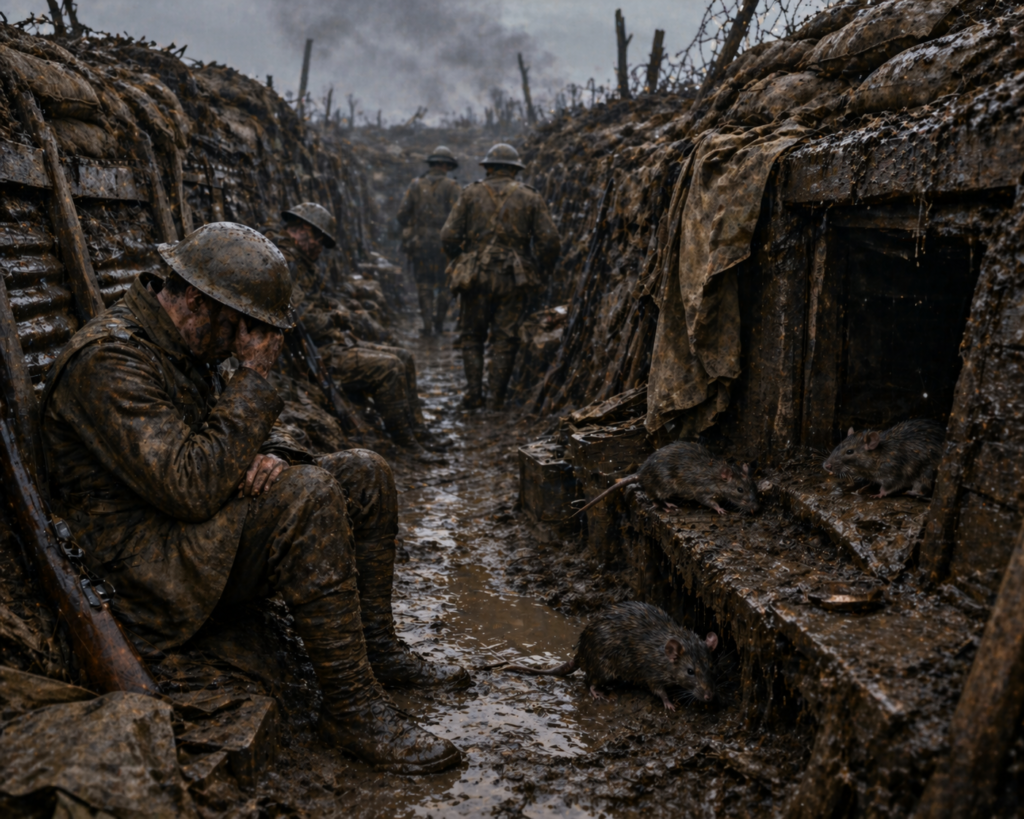
Image Credentials: Image Title: The Silence Between Shells: Life Inside the Trenches of World War I Source: (chatgpt.com) Date: April 2026. Attribution: This image was created using AI-generated imagery (chatgpt.com) and does not depict a real-world scene.
By José Carlos Palma*
Between the thunder of artillery and the sharp crack of rifle fire, there were long stretches of silence, heavy and suffocating. In those moments, inside the trenches of World War I, soldiers were left alone with something far more dangerous than bullets, their thoughts.
A World of Mud and Decay
The trenches stretched across the Western Front like scars carved into the earth. What began as temporary defensive positions quickly evolved into a complex system of dugouts, communication lines, and fortified walls. Yet no engineering could truly prepare men for the reality of living inside them.
Mud was everywhere. It swallowed boots, weapons, and sometimes entire men. After heavy rain, trenches collapsed, drowning soldiers where they stood. The ground itself became an enemy, unstable and unforgiving.
Rats thrived in this environment. Fat from feeding on scraps and the bodies of the fallen, they moved freely among the living. Lice spread rapidly, embedding themselves in uniforms and skin, creating a constant itch that never allowed proper rest.
The Psychology of Waiting
Combat was not continuous. Days could pass without an attack, only to be shattered in seconds by an artillery barrage. This unpredictability created a unique psychological strain.
Soldiers lived in anticipation of violence. Every distant sound could signal death. Sleep was shallow, often interrupted. Over time, many developed what was then called “shell shock”, a condition now understood as a form of psychological trauma.
Fear was constant, but so was routine. Cleaning weapons, repairing trench walls, standing watch, writing letters home. These small acts gave structure to an otherwise chaotic existence.
Moments of Humanity
And yet, even here, humanity endured.
There were stories of shared cigarettes, quiet jokes, and songs carried softly through the night. In rare and fragile moments, enemies revealed themselves not as monsters, but as men.
One of the most striking examples came during the Christmas of 1914, when soldiers on opposing sides laid down their weapons and met in no man’s land. They exchanged gifts, spoke, and in some cases, played football. For a brief moment, the war paused, not by command, but by choice.
The Cost Beyond the Battlefield
The trenches were not just physical structures; they were spaces where a generation was transformed. The war reshaped identities, societies, and the very idea of conflict.
When the guns finally fell silent in 1918, many soldiers returned home, but not truly. The war remained with them, in memory, in silence, and in the spaces between words.
The trenches of World War I were eventually filled, reclaimed by nature and time. But their legacy endures, a reminder that war is not only fought on battlefields, but within the minds of those who survive it.