
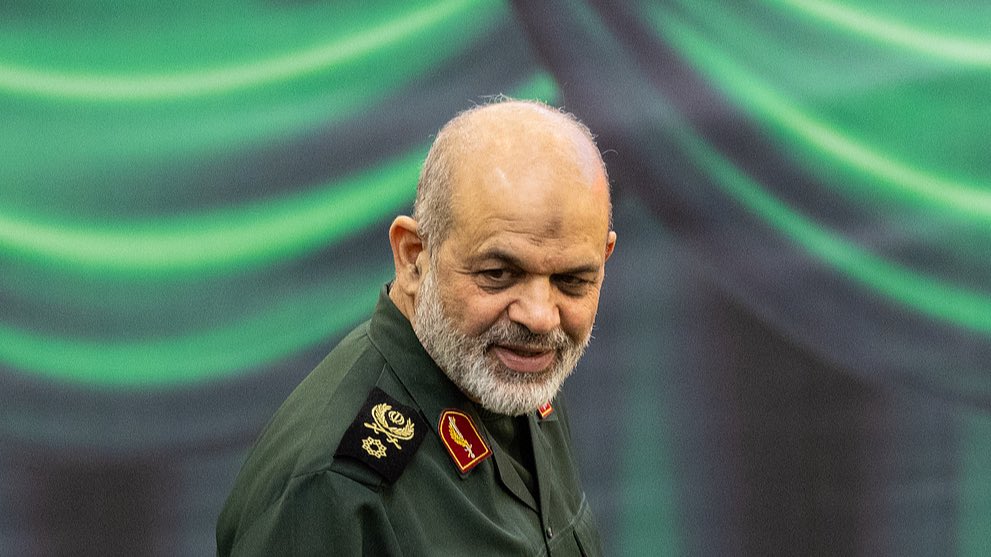
Image: from Open Source Intel X @Osint613
Open Chronicle | Global Security
As tensions between Tehran and Washington intensify ahead of a potential ceasefire decision, a little-known but highly influential figure is drawing increasing scrutiny. Ahmad Vahidi, recently elevated to lead Iran’s powerful Islamic Revolutionary Guard Corps, is emerging as one of the most consequential actors in the country’s strategic direction.
While public attention often focuses on political leaders such as Masoud Pezeshkian, analysts say real decision-making power is increasingly shifting toward figures within the Revolutionary Guard, with Vahidi now at the forefront.
A hardliner with deep roots in Iran’s security apparatus
Islamic Revolutionary Guard Corps, commonly known as the IRGC, is an elite branch of Iran’s military that plays a central role in both domestic control and foreign operations. Vahidi’s appointment to lead it signals, according to analysts, a consolidation of power among the regime’s most hardline elements.
Before taking on his current role, Vahidi led the IRGC’s external operations unit, the Quds Force, during the 1990s, laying the groundwork for Iran’s network of regional alliances and proxy groups. He preceded Qassem Soleimani, whose later prominence made the unit globally recognized.
Experts argue that Vahidi belongs to the original generation of operatives who helped build Iran’s influence abroad, particularly in Lebanon through ties with Hezbollah.
Allegations and international scrutiny
Over the years, Vahidi has been linked by Western governments and investigators to several major attacks attributed to Iran-backed networks. These include the 1994 bombing of a Jewish community center in Buenos Aires, one of the deadliest attacks in Argentina’s history, as well as earlier incidents targeting U.S. and allied interests.
Authorities in Argentina have sought his arrest in connection with the Buenos Aires attack, and international notices remain in place. He is also under sanctions from both the United States and the European Union, which restrict his international movement and financial activity.
In addition to allegations tied to foreign operations, Vahidi has faced criticism for his role in domestic repression. During his tenure as Iran’s interior minister, he was accused by Western officials of overseeing crackdowns on protests, including measures such as internet restrictions and mass arrests.
Power beyond formal institutions
Analysts increasingly describe Iran’s political system as one where influence depends less on official titles and more on networks of power. In this environment, Vahidi’s rise reflects a broader shift toward military figures shaping national strategy.
Some experts suggest that figures within the IRGC now wield more influence than traditional political institutions, particularly during times of crisis. This dynamic raises questions about who ultimately determines whether Iran pursues diplomacy or confrontation.
Implications for the current crisis
The timing of Vahidi’s rise is significant. With Donald Trump pressing Iran to extend a fragile ceasefire, decisions made within the IRGC could determine the next phase of the conflict.
Analysts warn that Vahidi’s record and ideological stance suggest a preference for a more confrontational approach. Even if a ceasefire is maintained, some believe it could be used as an opportunity to regroup rather than de-escalate.
Others caution that his leadership may reduce the likelihood of sustained negotiations, increasing risks for regional stability and global security.
A symbol of Iran’s direction
For many observers, Vahidi’s appointment is more than a personnel change. It reflects the trajectory of Iran’s leadership at a critical moment, one that appears to favor hardline strategies over compromise.
As diplomatic efforts continue and tensions remain high, the question is no longer only about Iran’s official position, but about the individuals shaping it behind the scenes.