
Image: from WELT X @welt
By Open Chronicle News Desk with Agencies
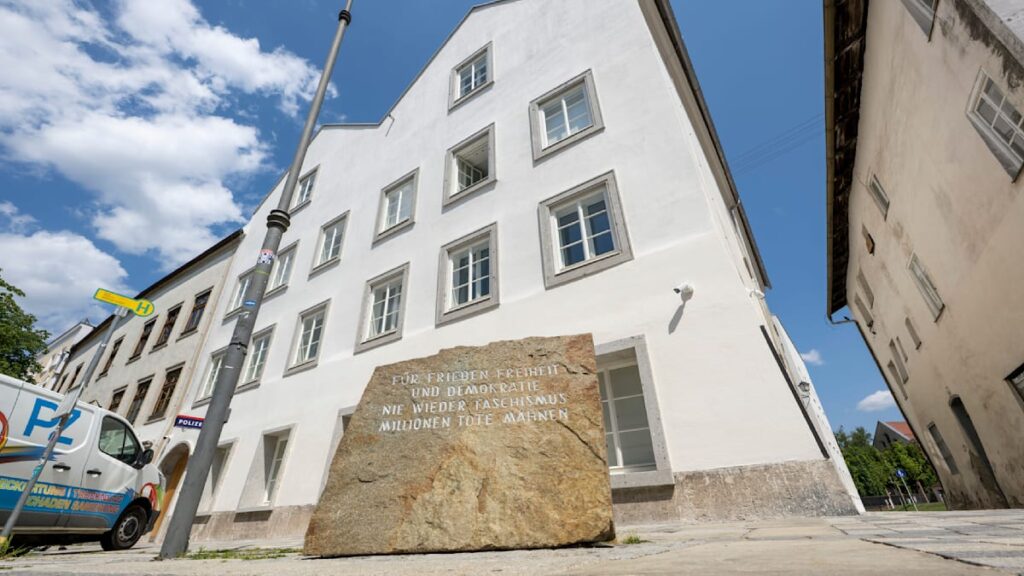
The house where Adolf Hitler was born in 1889 has officially begun a new chapter in its history after reopening as a police station, a move Austrian authorities hope will permanently strip the building of its symbolic appeal to neo-Nazis.
Located in the town of Braunau am Inn, near Austria’s border with Germany, the white terraced house has long been a source of controversy because of its association with the dictator responsible for the Holocaust and the Second World War.
The Austrian government believes converting the building into a functioning police facility will help prevent it from becoming a destination for extremists seeking to glorify Hitler.
A building with a troubled legacy
Adolf Hitler was born in the house on 20 April 1889, although he lived there for only a few weeks before his family moved elsewhere.
Despite the brief stay, the building later acquired enormous symbolic significance because of Hitler’s rise to power and the Nazi regime’s cult of personality.
During the Third Reich, the property was promoted as the “Führer’s Birth House” and even served as an art museum dedicated to Nazi propaganda.
Following the war, the building passed through various uses and, for many years, housed a charity supporting people with disabilities.
Government intervention
The Austrian government compulsorily purchased the property in 2017 after years of legal disputes with its private owners.
Two years later, officials announced plans to renovate the building and convert it into a police station.
The project was designed not simply to reuse the structure but to redefine its identity completely.
A new “Police” sign now appears on the building’s façade, replacing what had long been one of Europe’s most controversial addresses.
Stephan Mlczoch, head of the Austrian Interior Ministry’s history department, said the objective was to eliminate any lingering aura surrounding the site.
“The aim was to prevent any association with Adolf Hitler, to strip it of that mystique,” he explained.
Preventing extremist pilgrimages
Authorities say the conversion is intended to discourage neo-Nazi groups from gathering at the property.
While occasional visitors continue to stop outside to take photographs, local officials report that extremist incidents have become increasingly rare.
Austria maintains some of Europe’s strictest laws against Nazi symbolism.
The Hitler salute, Nazi insignia and other forms of Nazi propaganda are criminal offences, reflecting the country’s efforts to combat far-right extremism.
Supporters of the police station project argue that giving the building an active public function removes its attraction as a symbolic shrine.
A memorial that remains
Long before the renovation, the only indication of the building’s historical significance was a memorial stone placed outside.
The granite rock, brought from the Mauthausen concentration camp, bears the inscription:
“For peace, freedom and democracy. Never again fascism. Millions of dead remind us.”
Notably, the memorial makes no mention of Hitler himself.
The stone remains in place following the renovation, serving as a reminder of the victims of Nazism rather than the man responsible for their persecution.
Between 90,000 and 120,000 people died at Mauthausen, one of the Nazi regime’s most notorious concentration camps.
Debate over how history should be remembered
Not everyone supports the government’s approach.
The Mauthausen Committee, Austria’s leading Holocaust remembrance organisation, has criticised the decision to house a police station in the building.
Committee representatives argue that the site should place greater emphasis on educating visitors about Hitler’s crimes rather than attempting to minimise the building’s historical significance.
Robert Eiter, a member of both the Mauthausen Committee and the Network Against Racism and Right-Wing Extremism, warned that history cannot simply be erased.
“The world won’t forget where the worst mass murderer in history was born,” he said, arguing that the number of extremist visitors is unlikely to disappear entirely.
Local reaction
Opinion among Braunau residents appears mixed but generally supportive.
Mayor Johannes Waidbacher, who served on the commission recommending the building’s future use, said a charitable organisation would have left the property more accessible to the public and therefore less suitable for preventing extremist gatherings.
He acknowledged that only time would reveal whether the strategy succeeds.
Some residents expressed disappointment that the former charity did not remain in the building.
Others welcomed the transformation.
Estate agent Thomas Spreitz said the police station was an effective solution, arguing that occasional gatherings by neo-Nazi groups should now become a thing of the past.
Austria’s changing relationship with its past
For decades after the Second World War, Austria portrayed itself primarily as the first victim of Nazi Germany following the Anschluss of 1938.
In recent decades, however, the country has increasingly acknowledged that many Austrians also participated in Nazi crimes and persecution.
The conversion of Hitler’s birthplace reflects that continuing debate over how nations should confront painful chapters of their history.
Rather than preserving the house as a monument or demolishing it, Austrian authorities have chosen a different path: transforming one of Europe’s most infamous birthplaces into an institution dedicated to enforcing the law, while leaving nearby memorials to honour the millions who suffered under the regime that began there.