
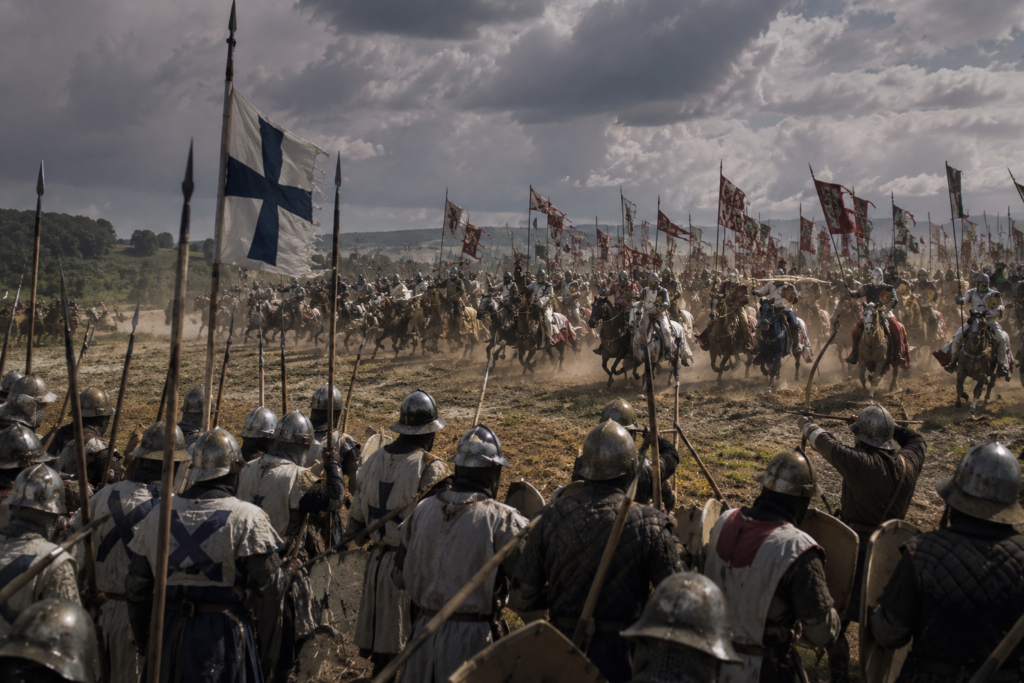
Image Credits: Today in History, August 14, 1385: The Battle of Aljubarrota Secures Portugal’s Independence. AI-generated illustration created by Open Chronicle using ChatGPT (OpenAI). August 2026. This image is illustrative and does not depict a real-world scene.
By Open Chronicle History Desk
On August 14, 1385, on fields near the small Portuguese town of Aljubarrota, one of the most consequential battles in the history of Portugal unfolded.
A Portuguese army commanded by King John I and his brilliant constable, Nuno Álvares Pereira, faced a considerably larger Castilian force led by King John I of Castile. The battle was about far more than territory. At stake was the Portuguese crown itself and, ultimately, whether Portugal would remain an independent kingdom.
Against the numerical superiority of their opponents, the Portuguese relied on careful preparation, disciplined defensive tactics and effective use of the terrain. Within hours, the Castilian army was defeated.
The victory at Aljubarrota secured the position of the new House of Aviz, strengthened Portugal’s independence, and helped create the political stability from which the kingdom would eventually emerge as one of the great maritime powers of the fifteenth and sixteenth centuries.
A Kingdom Without a King
The crisis that led to Aljubarrota began with the death of King Ferdinand I of Portugal in 1383.
Ferdinand had no surviving male heir. His only legitimate child, Beatrice, was married to King John I of Castile.
That marriage created a dangerous possibility.
If Beatrice inherited the Portuguese crown, Portugal could effectively fall under Castilian domination. Although arrangements had been made intended to preserve Portuguese institutions and political autonomy, many nobles, merchants, and urban communities feared that the kingdom’s independence was in danger.
The succession dispute quickly became a political and military crisis.
Ferdinand’s widow, Leonor Teles, initially acted as regent, but opposition to her government grew rapidly.
At the centre of the resistance emerged John, Master of Aviz, an illegitimate son of King Peter I of Portugal and therefore a half-brother of the late King Ferdinand.
Portugal entered the period remembered as the 1383–1385 Crisis.
Portugal Divided
The succession crisis was also a civil conflict.
Portuguese society was divided between supporters of Beatrice and the Castilian claim and those who supported the Master of Aviz.
Some members of the Portuguese nobility favoured Castile. Others joined the resistance.
Lisbon became one of the principal centres of support for John of Aviz.
Castilian forces invaded Portugal, and in 1384 King John I of Castile laid siege to Lisbon. The city resisted for months, while disease and logistical difficulties increasingly weakened the besieging army.
Eventually, the Castilians withdrew.
But the struggle for the Portuguese crown was not over.
One of the figures emerging as essential to the Portuguese resistance was a young commander whose reputation would become inseparable from Aljubarrota.
Nuno Álvares Pereira
Nuno Álvares Pereira had already demonstrated his military abilities before the decisive confrontation of 1385.
At the Battle of Atoleiros in April 1384, Portuguese forces under his command defeated a Castilian army. The victory strengthened the Aviz cause and demonstrated the effectiveness of disciplined infantry formations against mounted opponents.
Nuno Álvares Pereira became one of the principal military leaders supporting John of Aviz.
His importance was both strategic and symbolic.
While John provided the political focus for the independence movement, Nuno helped give it the military organisation necessary to survive.
In April 1385, the Cortes assembled at Coimbra proclaimed John of Aviz as King John I of Portugal.
The House of Aviz had been born.
Castile, however, did not accept the outcome.
A decisive confrontation was approaching.
The Castilian Invasion
King John I of Castile assembled a substantial army and invaded Portugal during the summer of 1385.
The Castilian king intended to defeat John of Aviz and enforce his claim to the Portuguese throne through his marriage to Beatrice.
The invading army was considerably larger than the force available to the Portuguese.
Portugal therefore faced a strategic problem.
Attempting to defeat the Castilians in an open battle without preparing the ground could have been disastrous.
Instead, the Portuguese command chose its battlefield carefully.
Near Aljubarrota, between Leiria and Alcobaça, Nuno Álvares Pereira selected a defensive position suited to reducing the advantages of the larger Castilian army.
There, on August 14, the fate of the kingdom would be decided.
Preparing the Battlefield
The Portuguese army occupied elevated terrain that restricted the ability of the Castilians to deploy their numerical superiority effectively.
Defensive preparations were made before the main attack.
Ditches, pits and other obstacles helped disrupt an advancing enemy. The Portuguese formations were positioned so that attackers would be channelled into a relatively narrow battlefield.
Portuguese infantry formed the core of the defence.
There was also an English contingent among the Portuguese forces, reflecting the developing relationship between Portugal and England.
Archers and crossbowmen supported the defensive position.
The strategy was clear.
Rather than attempt to match Castilian strength directly, the Portuguese would force the enemy to attack under unfavourable conditions.
It was an approach that echoed developments already transforming warfare in late medieval Europe, where disciplined infantry and missile troops could increasingly challenge the traditional dominance of heavily armoured cavalry.
The Battle Begins
The Castilian army reached the Portuguese position on August 14.
The strength of the defensive deployment was apparent, and the Castilians initially considered manoeuvring around it rather than launching a direct assault.
The Portuguese adjusted their position accordingly.
Eventually, battle became unavoidable.
Castilian forces advanced against the Portuguese lines.
The restricted terrain made it difficult to exploit their greater numbers. Defensive obstacles disrupted formations, while Portuguese missile troops attacked the advancing enemy.
As the fighting intensified, the battlefield became increasingly congested.
The Portuguese formations held.
The Castilian army, despite its numerical superiority, struggled to break through.
The Portuguese Line Holds
The central phase of the battle became a brutal close-range struggle.
Portuguese troops maintained their defensive formation while the Castilian assault lost momentum.
Nuno Álvares Pereira’s preparations had achieved their purpose.
The battlefield itself had become a weapon.
Castilian forces could not deploy effectively, and troops arriving from behind added pressure to formations already engaged at the front.
The Portuguese counterattacked.
What had begun as an attempt to overwhelm the smaller Portuguese army now turned into a crisis for the Castilians.
Their formations began to collapse.
Once the retreat started, disorder spread rapidly.
King John I of Castile escaped from the battlefield, but his army had suffered a catastrophic defeat.
Portugal had won.
A Decisive Victory
The Battle of Aljubarrota lasted only a relatively short time, but its political consequences were enormous.
The Castilian attempt to impose its claim to the Portuguese throne had been decisively weakened.
John I’s position as King of Portugal was strengthened, while the House of Aviz gained the military legitimacy necessary to establish itself securely.
The victory also elevated Nuno Álvares Pereira to the status of national hero.
He would later become Constable of Portugal and one of the most celebrated military figures in Portuguese history.
Centuries later, he was canonised by the Catholic Church as Saint Nuno of Saint Mary.
The Alliance with England
The crisis also strengthened Portugal’s relationship with England.
English troops had participated alongside the Portuguese at Aljubarrota, while political cooperation between the two kingdoms continued after the battle.
In 1386, Portugal and England concluded the Treaty of Windsor.
The alliance was reinforced the following year when John I married Philippa of Lancaster, daughter of John of Gaunt.
The Anglo-Portuguese relationship would become one of the most enduring diplomatic alliances in European history.
The marriage also produced a generation of royal children closely associated with Portugal’s transformation during the fifteenth century.
Among them was Prince Henry the Navigator.
The Monastery of Batalha
John I had vowed to construct a monastery in gratitude for victory.
The result was the Monastery of Santa Maria da Vitória, better known as the Monastery of Batalha.
Construction began after the battle and continued across generations.
The monastery became one of the great monuments of Portuguese Gothic architecture and a permanent memorial to the victory of 1385.
John I and Philippa of Lancaster were eventually buried there.
Their tombs transformed Batalha into both a royal mausoleum and a monument to the dynasty that emerged from the succession crisis.
The battlefield and monastery remain among the most important historical sites connected with medieval Portugal.
From Aljubarrota to the Age of Discovery
Aljubarrota did not itself create the Portuguese maritime expansion that followed in the next century.
But the political settlement produced by the victory helped establish the conditions from which that expansion emerged.
The House of Aviz consolidated royal authority and presided over a kingdom increasingly oriented toward the Atlantic.
In 1415, Portuguese forces captured Ceuta in North Africa.
During the following decades, Portuguese navigators moved progressively farther along the western coast of Africa.
Madeira and the Azores became part of Portugal’s Atlantic world.
By the end of the fifteenth century, Bartolomeu Dias had rounded the Cape of Good Hope, Vasco da Gama had reached India by sea, and Portuguese voyages had helped transform European knowledge of the world.
The dynasty secured at Aljubarrota would therefore preside over one of the most consequential periods in Portuguese and global history.
The Legend of the Baker of Aljubarrota
Like many great battles, Aljubarrota also generated legends.
The most famous concerns Brites de Almeida, remembered as the Baker of Aljubarrota.
According to Portuguese tradition, several Castilian soldiers fleeing the battlefield hid inside her bakery. Brites discovered them and killed them with her baker’s shovel.
The historical evidence surrounding the story is uncertain, and the figure belongs largely to Portuguese popular tradition.
Yet the endurance of the legend demonstrates how deeply Aljubarrota entered national memory.
The battle became not merely a victory of kings and commanders, but a story associated with the defence of the kingdom by ordinary Portuguese people.
Why Aljubarrota Matters
The Battle of Aljubarrota occupies a unique place in Portuguese history.
It was a military victory, but its importance extended far beyond the battlefield.
It secured the throne of John I.
It consolidated the House of Aviz.
It frustrated Castilian ambitions to control the Portuguese crown.
It strengthened Portugal’s relationship with England.
Most importantly, it ensured the survival of Portugal as an independent political kingdom at one of the most dangerous moments in its medieval history.
The consequences would extend into the following century, when the political order created after the crisis of 1383–1385 helped provide the foundations for Portugal’s Atlantic expansion.
On August 14, 1385, a smaller army stood on carefully chosen ground near Aljubarrota and defeated a more powerful opponent.
The battle lasted hours.
Its consequences shaped centuries.