
By Open Chronicle Explained
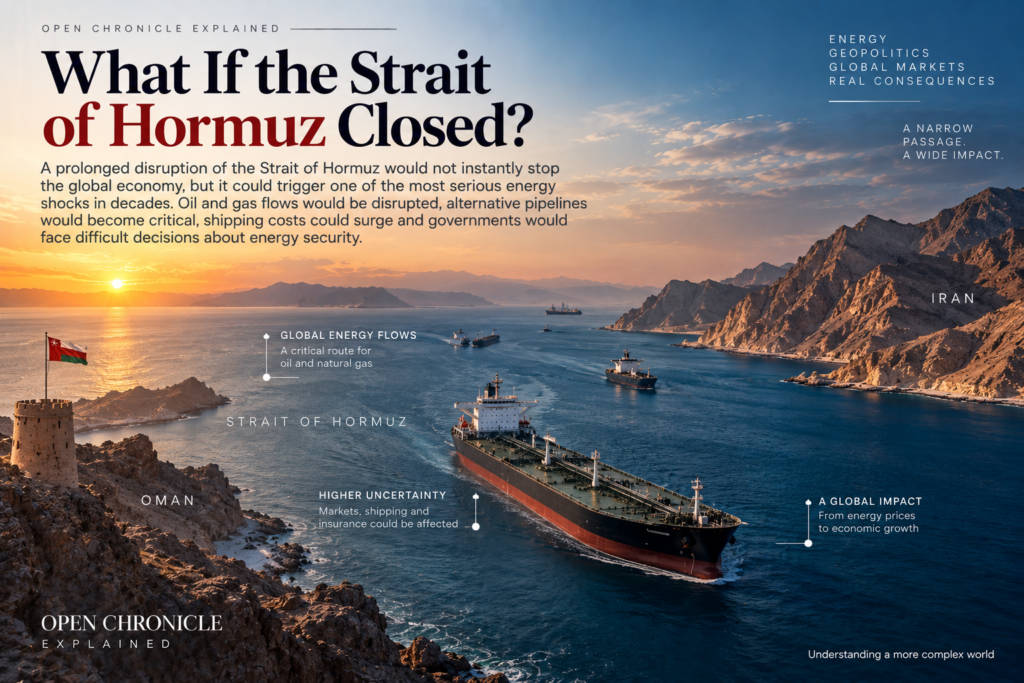
The Strait of Hormuz is only a narrow passage of water between Iran and Oman.
But imagine that commercial shipping could no longer pass through it.
Tankers stop.
Insurance companies withdraw or impose extraordinary premiums.
Ships already inside the Persian Gulf wait for instructions.
Oil producers activate alternative export routes.
Energy traders attempt to calculate how long the disruption might last.
Governments call emergency meetings.
Oil prices react.
What happens next?
The answer depends on one crucial variable:
How long does the disruption last?
A closure lasting several hours would be very different from one lasting several weeks.
A partial disruption would be different from a complete interruption of commercial traffic.
And a physical blockage would be different from a situation in which the strait technically remained open but shipowners considered it too dangerous to enter.
There is therefore no single answer to the question.
But exploring the scenario reveals how deeply global energy markets depend on geography.
First, what does “closed” actually mean?
The phrase “closing the Strait of Hormuz” sounds straightforward.
In reality, several different scenarios could produce similar economic consequences.
The waterway could theoretically become physically obstructed.
Naval mines could make navigation dangerous.
Missile or drone attacks could threaten commercial vessels.
Military confrontation could cause shipping companies to suspend operations.
Insurers could decide that the risks were unacceptable.
Ports could reduce activity.
Crews could refuse to enter the region.
Governments could issue warnings affecting maritime traffic.
In some of these scenarios, the strait would remain physically navigable.
But economically, the result could still resemble a partial closure.
This distinction is important.
Global trade depends not only on whether a route exists, but on whether commercial operators are willing and able to use it.
What would happen in the first few hours?
Financial markets would probably react faster than physical energy supplies.
Oil already stored in tanks around the world would not suddenly disappear.
Petrol stations would not immediately run dry.
Refineries outside the region would continue operating using existing inventories and supplies already in transit.
But traders would immediately begin reassessing future availability.
Oil prices are influenced by expectations.
If markets believed a major share of Gulf exports might become unavailable for an extended period, prices could rise before any physical shortage reached consumers.
The first shock would therefore be psychological and financial.
The world would begin pricing the possibility of scarcity.
Would oil exports from the Persian Gulf stop completely?
No.
This is one of the most important qualifications.
Several Gulf producers possess infrastructure that can bypass the Strait of Hormuz.
Saudi Arabia operates the East West pipeline, which can move crude from the kingdom’s eastern producing region toward Yanbu on the Red Sea.
The United Arab Emirates has a pipeline connecting the Abu Dhabi oil producing region with Fujairah, which lies outside the Strait of Hormuz.
Other infrastructure and storage facilities would also contribute to the response.
These systems exist partly because governments understand the strategic vulnerability created by Hormuz.
But bypass capacity is not equivalent to the normal volume of maritime exports passing through the strait.
Alternative routes could soften the shock.
They could not simply make Hormuz irrelevant.
Why couldn’t Saudi Arabia just send everything through the Red Sea?
Because pipelines have capacity limits.
A pipeline can only transport a certain volume of crude within its technical operating limits.
The same is true of pumping stations, storage tanks and export terminals.
Even if additional pipeline capacity were available, logistics would need to adjust.
More crude arriving at Red Sea terminals would require tanker capacity, storage coordination and port operations.
And not every Gulf producer has direct access to Saudi infrastructure.
A bypass route can provide strategic resilience without being capable of replacing the entire maritime system.
This is why headline figures describing maximum pipeline capacity need to be interpreted carefully.
Maximum capacity is not necessarily the amount normally transported through the system.
What would happen to oil prices?
They would likely become highly volatile.
The size of the price movement would depend on the expected duration and severity of the disruption, global inventories, spare production capacity elsewhere and the credibility of international responses.
Markets would ask several questions simultaneously.
How much oil is actually unavailable?
How long will the disruption last?
Can alternative pipelines carry more crude?
Can producers elsewhere increase output?
Will governments release emergency reserves?
Will demand fall because prices rise?
Could military action restore safe navigation?
Markets constantly update prices as answers to those questions change.
A brief disruption followed by rapid restoration of shipping could produce a sharp but temporary price spike.
A prolonged crisis would create a much more serious challenge.
Would petrol prices immediately rise?
Not necessarily immediately, but sustained increases in crude oil prices would eventually affect refined fuel markets.
The relationship is not perfectly instantaneous.
Petrol and diesel prices depend on several factors beyond crude oil, including refining costs, taxes, distribution, currency movements and regional market conditions.
But crude oil is a major input.
If international oil prices remained significantly higher, consumers would eventually feel some of that increase.
The effects would extend beyond private cars.
Airlines buy aviation fuel.
Shipping companies buy marine fuels.
Trucking depends heavily on diesel.
Agriculture uses fuel.
Petrochemicals use oil and gas as feedstocks.
An energy shock can therefore spread through the wider economy.
What would happen to inflation?
Potentially, it could increase.
Energy is embedded in the cost structure of almost everything.
Factories consume electricity and fuel.
Goods must be transported.
Aircraft move people and cargo.
Ships carry international trade.
Farms use machinery and fertilizers.
Buildings require heating and cooling.
When energy prices rise sharply, companies face higher costs.
Some absorb those costs.
Others pass them on to customers.
This can contribute to inflation.
Central banks would then face an uncomfortable problem.
Higher energy prices can increase inflation while simultaneously weakening economic growth.
Raising interest rates might reduce inflationary pressure but could also place additional strain on an economy already suffering from an external energy shock.
What about natural gas?
This could be extremely important.
Qatar is one of the world’s largest exporters of liquefied natural gas.
Its LNG carriers leave the Persian Gulf through the Strait of Hormuz.
A sustained disruption could therefore affect international gas markets as well as oil.
The consequences would vary significantly by region.
Countries with diversified gas supplies, extensive storage and alternative LNG sources would be better positioned than countries heavily dependent on particular import routes.
LNG markets could respond by redirecting cargoes.
But rerouting does not create additional gas.
If supply available to the global market fell significantly, buyers could compete for remaining cargoes.
That competition could drive prices higher.
Why would Asia be particularly exposed?
Because a large share of Gulf energy exports travels east.
China, India, Japan, South Korea and other Asian economies import substantial quantities of energy from the Gulf.
Their exposure would differ depending on national energy mixes, strategic reserves, contracts and alternative suppliers.
But geographically, Asian markets are central to Gulf energy trade.
A Hormuz crisis would therefore not simply be a Middle Eastern event.
It could become an Asian energy security crisis and, through the global economy, a worldwide economic problem.
What would happen to tankers?
Ships already outside the Persian Gulf could avoid entering.
Those inside would face a much more difficult situation.
They might remain at anchor or in port until safe passage became possible.
Shipping companies would assess threats continuously.
Charter rates could increase.
Insurance costs could rise dramatically.
War risk premiums could become significant.
Crews and shipowners would demand greater compensation for operating in dangerous waters.
This creates another important effect.
Even if oil itself did not become dramatically more expensive at the production point, the cost of moving it could rise.
Could tankers simply take another route?
Not if they are loading oil from ports inside the Persian Gulf.
There is no second maritime exit.
This is what makes Hormuz a chokepoint.
A ship cannot leave Kuwait, Qatar, Bahrain or the northern Gulf and sail around the strait while remaining at sea.
Alternative routes require moving the energy over land before it is loaded onto a tanker.
That means pipelines.
Geography cannot be negotiated.
Could other oil producers replace the missing supply?
Partially, depending on circumstances.
Oil producers outside the Persian Gulf might be able to increase output.
Commercial inventories could be drawn down.
Governments could release strategic reserves.
Refiners could change crude sourcing where technically possible.
Demand might also decline in response to higher prices.
But replacing several million barrels per day of disrupted supply would be a very different challenge from compensating for a small production outage.
The global oil market is enormous, but spare capacity is not unlimited.
And replacement barrels may be located far from the refineries that need them.
Logistics matter as much as production.
What are strategic petroleum reserves?
Many governments maintain emergency oil stocks precisely because severe supply disruptions are possible.
The United States maintains the Strategic Petroleum Reserve.
Members of the International Energy Agency have emergency stockholding obligations and mechanisms for coordinating responses to major disruptions.
Other countries maintain their own reserves.
These stocks can release oil into the market during emergencies.
The objective is not necessarily to replace every lost barrel indefinitely.
Strategic reserves buy time.
They can reduce immediate shortages, reassure markets and allow governments and industry to reorganize supply chains.
But reserves are finite.
The longer a disruption lasts, the more important that limitation becomes.
What would happen after one week?
By this stage, the difference between a temporary incident and a genuine energy crisis would become clearer.
Alternative pipelines would likely be operating as intensively as practical.
Governments would be coordinating emergency responses.
Tankers would be repositioned.
Refiners would seek alternative crude supplies.
Strategic stocks might begin entering markets.
Energy intensive industries would start assessing costs.
Airlines and transport companies could face higher fuel prices.
Financial markets would begin incorporating the possibility of slower global economic growth.
The world would still have energy.
But the system would be operating under stress.
What if the disruption lasted a month?
The economic consequences could become much more severe.
Inventories would decline.
Emergency reserves would become increasingly important.
Competition for alternative oil and LNG supplies could intensify.
Some refineries might struggle to obtain their preferred crude grades.
Governments could introduce measures to reduce consumption.
Businesses would face sustained increases in transport and energy costs.
Inflation expectations could rise.
Economic growth forecasts could fall.
Countries with limited financial resources and heavy dependence on imported energy could be particularly vulnerable.
A prolonged Hormuz disruption would therefore become more than an energy problem.
It could become a global macroeconomic shock.
Could governments ration fuel?
In an extreme and prolonged crisis, governments have several tools available.
They could reduce fuel taxes temporarily.
They could subsidize certain consumers.
They could prioritize supplies for emergency services and critical infrastructure.
They could encourage or mandate conservation.
They could impose restrictions on some forms of consumption.
The exact response would depend on the severity of shortages and national policies.
Fuel rationing would be an extraordinary measure, not an automatic consequence of disruption.
But history shows that governments can intervene heavily in energy markets during severe supply emergencies.
Would renewable energy protect countries from the shock?
To some extent.
Countries generating large amounts of electricity from nuclear, hydroelectric, wind or solar power may be less directly exposed to oil and gas price shocks in their electricity systems.
Electric vehicles can also reduce dependence on petroleum for road transport.
But modern economies remain interconnected.
A country using little oil for electricity may still depend on diesel trucks, aviation fuel, imported goods and industries exposed to global energy prices.
Renewables therefore improve certain dimensions of energy security without completely isolating an economy from a global oil shock.
Would Europe be affected?
Yes.
Even if European refiners did not receive every barrel directly from the Persian Gulf, oil is traded globally.
A major disruption affecting Asian buyers would alter worldwide trade flows.
Asian refiners would seek replacement supplies.
Those barrels might otherwise have gone elsewhere.
Prices would adjust across interconnected markets.
Natural gas markets could also be affected through competition for LNG.
This is why energy security cannot be understood purely through direct bilateral imports.
A global commodity shock can affect countries that never purchased the disrupted cargo.
What about the United States?
The United States produces large quantities of oil and gas domestically, which provides substantial protection compared with periods when it was much more dependent on imported petroleum.
But it is not economically isolated from world oil prices.
Crude and refined products are traded internationally.
A severe global price increase would therefore still affect American consumers and businesses.
Domestic production reduces vulnerability to physical supply shortages.
It does not completely disconnect the economy from global energy markets.
Could a closure trigger a recession?
It could contribute to one, especially if the disruption were prolonged and prices rose dramatically.
Energy shocks can reduce household purchasing power.
Consumers spending more on fuel have less money for other goods and services.
Businesses face higher costs.
Inflation can constrain central bank policy.
Investment can weaken because uncertainty rises.
Financial markets can fall.
Countries that import large quantities of energy can see their trade balances deteriorate.
Whether this would produce a global recession would depend on the scale of the shock and the condition of the world economy when it occurred.
A strong economy might absorb a temporary increase.
A fragile economy could be pushed into contraction.
Would military forces try to reopen the strait?
The strategic importance of Hormuz means a sustained attempt to prevent international shipping would create enormous pressure for a response.
Several countries maintain significant naval capabilities in and around the Gulf.
Operations could theoretically involve escorting commercial vessels, clearing mines, protecting shipping lanes or responding to attacks.
But military intervention would introduce additional risks.
Escalation could threaten ports, energy facilities and regional infrastructure.
The objective of restoring maritime security could therefore coexist with the danger of making the broader conflict worse.
There is no simple military switch that guarantees normal commercial shipping.
Why would insurance matter so much?
Because modern shipping depends on financial risk management.
A tanker may be physically capable of entering a dangerous region.
But the owner, charterer, crew, cargo owner and insurer all have interests in the voyage.
If insurers classify an area as extremely dangerous, premiums can rise dramatically.
In extreme circumstances, coverage may become difficult to obtain.
This can stop or reduce commercial activity without any government formally closing a waterway.
Insurance is therefore part of the hidden infrastructure of global trade.
Ships need safe routes.
They also need economically acceptable risk.
Could pipelines permanently replace Hormuz after a crisis?
A prolonged disruption would almost certainly increase political interest in alternative infrastructure.
Gulf producers might expand pipelines.
Export terminals outside the Persian Gulf could receive additional investment.
Importing countries might diversify suppliers.
Governments could expand strategic reserves.
Renewable energy and electrification might gain additional strategic value.
But constructing major energy infrastructure takes years.
The immediate crisis would still have to be managed using the systems already available.
This is a recurring lesson in infrastructure.
Resilience must usually be built before the emergency begins.
Would the global economy eventually adapt?
Yes.
Economies adapt to price signals and scarcity.
Producers increase output where possible.
Consumers reduce demand.
Companies redesign supply chains.
Governments change policies.
New infrastructure gets built.
Alternative technologies become more competitive.
But adaptation has a cost.
The question is not whether the global economy could eventually function with less dependence on Hormuz.
It could.
The question is how disruptive and expensive the transition would be if it happened suddenly rather than gradually.
The Bigger Picture
A prolonged closure of the Strait of Hormuz would reveal something fundamental about the modern global economy.
It is enormously sophisticated.
But it is still constrained by geography.
Oil extracted from underground reservoirs must physically move.
Tankers need navigable waterways.
Pipelines have finite capacity.
Ports can only handle so many ships.
Strategic reserves contain finite quantities.
Insurance depends on acceptable risk.
Markets depend on expectations about all of these things.
That is why a narrow stretch of water can influence prices in cities thousands of kilometres away.
A disruption would not mean that the world instantly ran out of oil.
It would mean that one of the principal routes connecting major energy producers with global consumers had suddenly become unreliable.
The system would respond.
Pipelines would carry more crude.
Tankers would change routes.
Governments would release reserves.
Producers elsewhere would search for additional supply.
Consumers would adapt.
But every adjustment would reveal the same underlying reality.
The Strait of Hormuz matters because global energy abundance is only useful if energy can reach the people who need it.
And sometimes, an enormous part of that journey depends on a very small piece of geography.
Open Chronicle Explained
What If?
Exploring scenarios to understand how the world responds when something important changes.
Understanding the systems behind the headlines.
Explore Open Chronicle Explained →